Learning-Day03
Let's Learn Python
# Day-03
Python Variables
Variable is a name that is used to refer to memory location. Python variable is also known as an identifier and used to hold value.
In Python, we don't need to specify the type of variable because Python is a infer language and smart enough to get variable type.
Variable names can be a group of both the letters and digits, but they have to begin with a letter or an underscore.
-------------------------------------------------------------------------------
------------------------------------------
Identifier Naming
Variables are the example of identifiers. An Identifier is used to identify the literals used in the program. The rules to name an identifier are given below.
- The first character of the variable must be an alphabet or underscore ( _ ).
- All the characters except the first character may be an alphabet of lower-case(a-z), upper-case (A-Z), underscore, or digit (0-9).
- Identifier name must not contain any white-space, or special character (!, @, #, %, ^, &, *).
- Identifier name must not be similar to any keyword defined in the language.
- Identifier names are case sensitive; for example, my name, and MyName is not the same.
- Examples of valid identifiers: a123, _n, n_9, etc.
- Examples of invalid identifiers: 1a, n%4, n 9, etc.-
-----------------------------------------------------------------------------
----------------------------
Declaring Variable and Assigning Values
Python does not bind us to declare a variable before using it in the application. It allows us to create a variable at the required time.
We don't need to declare explicitly variable in Python. When we assign any value to the variable, that variable is declared automatically.
The equal (=) operator is used to assign value to a variable.
-------------------------------------------------------------------------------
-------------------------------
Object References
It is necessary to understand how the Python interpreter works when we declare a variable. The process of treating variables is somewhat different from many other programming languages.
__________________________________________________________
Python is the highly object-oriented programming language; that's why every data item belongs to a specific type of class. Consider the following example.
Output:
Sreeram
The Python object creates an integer object and displays it to the console. In the above print statement, we have created a string object. Let's check the type of it using the Python built-in type() function.
Output:
<class 'str'>
In Python, variables are a symbolic name that is a reference or pointer to an object. The variables are used to denote objects by that name.
Let's understand the following example
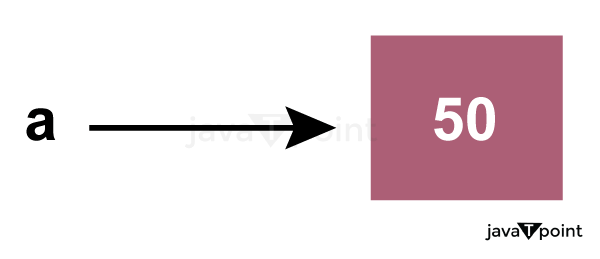
In the above image, the variable a refers to an integer object.
Suppose we assign the integer value 50 to a new variable b.
a = 50
b = a
b = a
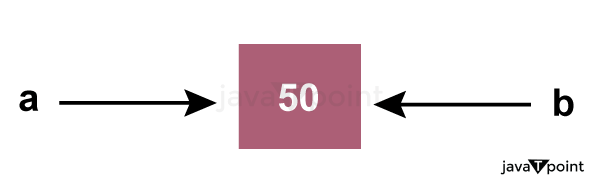
The variable b refers to the same object that a points to because Python does not create another object.
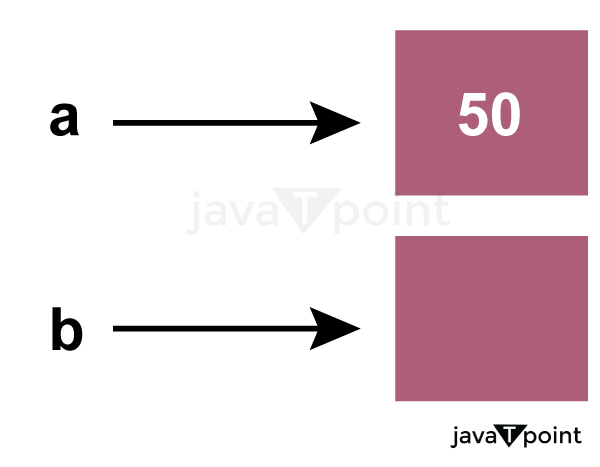
Let's assign the new value to b. Now both variables will refer to the different objects.
a = 50
b =100
b =100
---------------------------------------------------------------------------------
-------------------------------------------
Consider the following valid variables name.
Output:
A B C D E D E F G F I
In the above example, we have declared a few valid variable names such as name, _name_ , etc. But it is not recommended because when we try to read code, it may create confusion. The variable name should be descriptive to make code more readable.
-------------------------------------------------------------------------------------------------------------------------------------------------------
Any Doubts Regarding to All topics will be covered by the next session @
27-June
To download this Material_click the below link:

-----------------------------------------------------
Best Regards:
Venkata Sreeram
___________________________________________________________________
Thank you soo much for your Valuable time

Comments
Post a Comment